
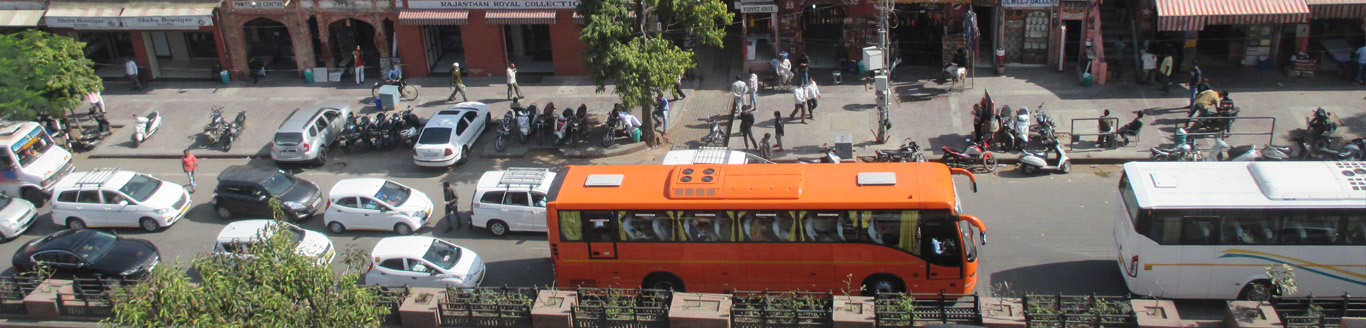

Speed is one of the most critical determinants of road safety, especially on urban roads where different users – pedestrians, cyclists, two-wheeler riders, public transport, and private vehicles – share limited space. Yet, public discourse often focuses on “average speed” and congestion, while overlooking the concept of “safe speed”. Understanding the difference between safe speed and average speed is essential for creating cities that are not only mobile, but also safe and liveable.
The recent TOM-TOM Survey of traffic index ranking 20251 shows average speeds of Indian cities like Bangalore ranking 2nd with avg. speed of 16.6 km/h and Pune at 5th with avg. speed of 18 km/h in the world, where Pune has shown slight improvement by 10%, authorities aim for an avg. speed of 30 km/h in subsequent years. This shows that the trend is still around average speed and every city’s transport planning authorities are running behind improving average speeds in the cities. More often we see our city planners, traffic engineers and traffic authorities responsible for traffic movement and setting of speeds are engaged in discussing average speed over safe speeds.
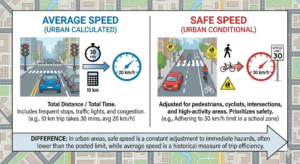
What is average speed?
Average speed refers to how fast vehicles travel over a given distance or period of time (calculated). In urban planning discussions, average speed is often used as an indicator of traffic performance – higher average speeds are perceived as better “flow”, while lower speeds are seen as congestion. As average speeds have a combination of variable speeds driven at different road stretches at different times, often motorists do speed in speed-favourable road stretches to make up for lost time in congested road stretches. These speed-favourable road stretches become more vulnerable zones for severe crashes and fatalities especially for the vulnerable road users. Many infrastructure projects aim to increase average speed by widening roads, adding flyovers, or removing intersections (signal free corridors).
However, higher average speed does not automatically translate into better mobility or safety. In fact, on urban roads, higher speeds often increase crash severity, discourage walking and cycling, and make streets hostile for vulnerable road users.
What is safe speed?
Safe speed is the maximum speed at which a vehicle can travel while still allowing drivers to respond to unexpected situations and ensuring that, if a crash occurs, the risk of serious injury or death is minimised. Safe speed depends on the road environment (conditional)- land use, presence of pedestrians, cyclists, intersections, roadside activity, and traffic mix.
Safe speeds on urban roads for example:
— On streets with high pedestrian activity, a safe speed is typically 30 km/h or lower.
— On streets with high risk zones like schools, a safe speed is 25 km/h or lower.
— On roads with limited access and controlled crossings, safe speeds is upto 50 km/h.
Safe speed is therefore context-specific, not uniform.
Why Safe Speed Matters More Than Average Speed in Cities
Urban roads are fundamentally different from highways. They are places of movement and places of activity. People cross streets, wait for buses, shop, cycle, and interact. At higher speeds, drivers have less time to react, and the human body has little tolerance for high-impact collisions.
Research consistently shows that:
— A pedestrian hit at 30 km/h has a high chance of survival.
— At 50 km/h, the risk of death increases dramatically.
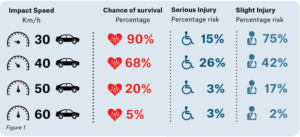
Thus, even small increases in speed lead to disproportionately higher fatality risk. Focusing only on increasing average speed ignores this reality. A city may achieve higher average speeds but also experience more severe crashes and higher fatalities.
The Myth: Lower Speeds Mean More Congestion
A common concern is that reducing speed limits will slow traffic and worsen congestion. In practice, urban congestion is primarily caused by intersections, traffic signals, parking activity, and traffic volume—not posted speed limits.
On many urban corridors, vehicles rarely travel at their posted maximum speed for long. Managing speeds to safer levels often leads to smoother flow, fewer harsh accelerations and braking, and more predictable movement. This can actually stabilize traffic rather than slow it down.
Moreover, cities that adopt safe speed policies often complement them with better public transport, walking, and cycling infrastructure—reducing dependency on private vehicles and easing congestion.
Design for Safe Speed, Not Just Signage
Posting lower speed limits alone is insufficient. Roads must be designed to “self-explain” the intended speed through:
— Narrower lane widths
— Raised pedestrian/ table top crossings
— Curb extensions
— Speed tables and humps
— Chicanes and lane shifts
— Compact intersection geometry
When the physical design communicates that a street is meant for 30 km/h, drivers naturally comply.
Helsinki achieved zero pedestrian, cyclist, and passenger fatalities in 2024-2025 by implementing “Vision Zero” strategies, primarily by reducing speed limits to 30 km/h on most residential streets. The city’s success, with no traffic deaths recorded between July 2024 and July 2025, was supported by improved infrastructure, new speed cameras, and redesigning streets to prioritise vulnerable users.2
Average Speed Still Has a Role – But Secondary
Average speed can be a useful operational metric for public transport planning or corridor performance. However, it should never override safety considerations. The primary objective on urban roads must be to keep speeds within survivable limits.
Towards a Safe Speed Culture
Cities must shift from “how fast can vehicles move?” mindset to “how safe are people on this street?” mindset. This means:
— Setting speed limits based on road function, design level of service and land use.
— Enforcing speeds consistently.
— Redesigning streets to match intended speeds.
— Communicating that speed management saves lives.
Conclusion
On urban roads, safe speed is more important than high average speed. While average speed focuses on movement efficiency, safe speed focuses on human survival. A city that prioritises safe speeds creates streets where children can cross safely, cyclists can ride without fear, and communities can thrive. Ultimately, true urban mobility is not about moving vehicles faster – it is about enabling people to move safely.
Footnotes
1. https://www.tomtom.com/traffic-index/ranking/
2. https://www.dw.com/en/no-traffic-deaths-in-helsinki-finland-thanks-to-smart-city-planning/a-73616778
Authored by:
Ar. Aditya Chawande, Senior Programme Associate and Urban Designer at Parisar, Member of Road Safety Network
risk analysis, safe by design, safe speed, speed limit