
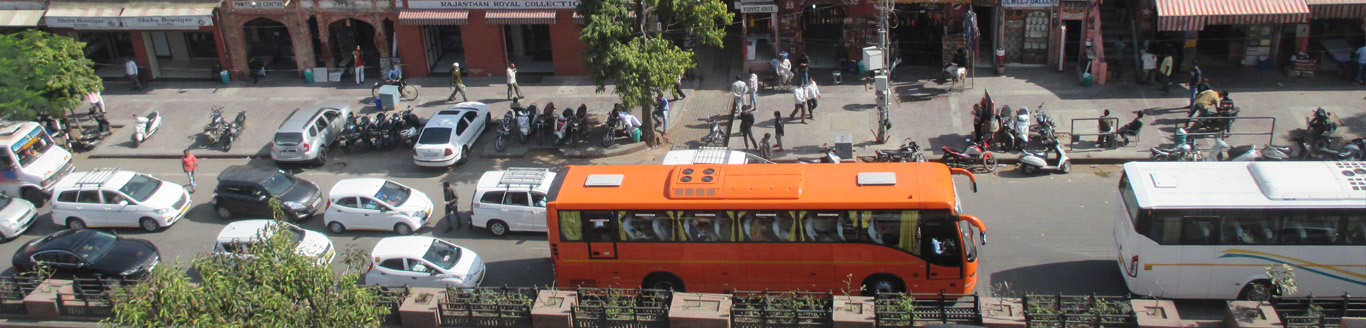

Kavita was driving in Pune with her driving instructor beside her. She wanted to change lanes, so she glanced over her shoulder to check the “blind spot.” The instructor shouted at her, “गाड़ी चलाते वक्त हमेशा सामने देखो, मैडम! (Madam, always look in front of you while driving!)” Kavita had learned to drive in the United States and had driven there for a good ten years. She had returned to India and only wanted to take a few lessons to get used to the traffic in Pune.
It is highly likely that a good number of crashes on our expressways happen because people don’t check blind spots, yet this “instructor” did not know such a basic thing as blind spots. Things may have improved a bit since Kavita narrated this incident to me twenty years ago; but even today, most driving schools focus only on the mechanical control of the vehicle. After all, why would they bother to inculcate in you the ability to share the road safely with others if it is not tested?
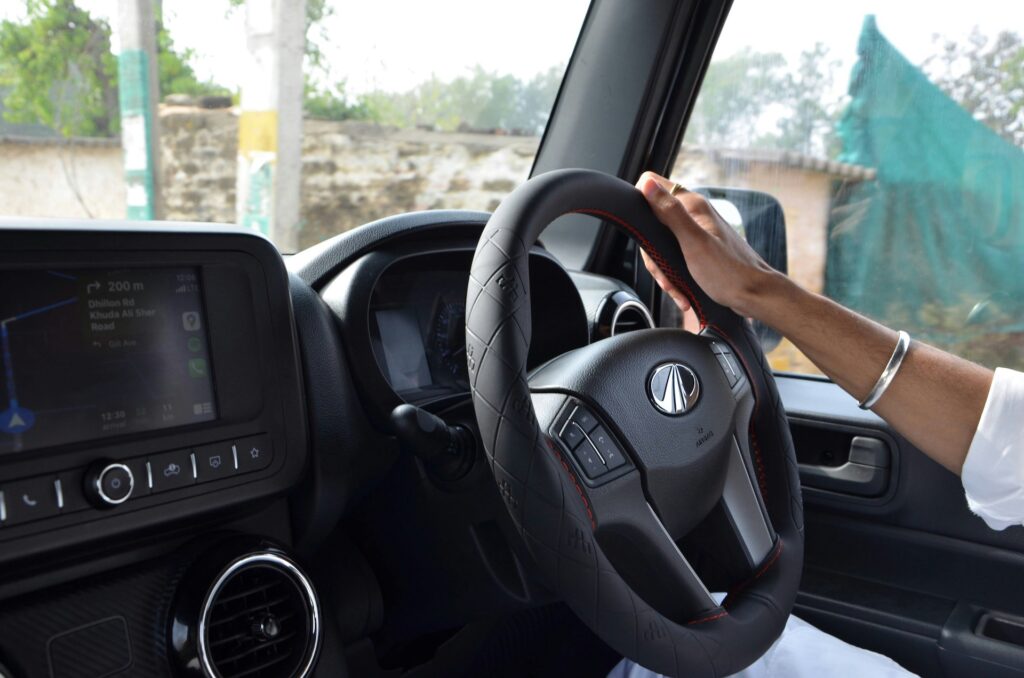
A driver’s-eye view inside a car, where attention, anticipation and judgment matter as much as mechanical control. Photo by Saiyam Arora on Unsplash
What can inspectors at Regional Transport Offices (RTOs) realistically test in sixty seconds, when there are hundreds of applicants and just a handful of inspectors in any RTO?
Let us compare this situation with the process of issuing passports. There have always been hundreds of applicants. Until a few years ago, one had to wait several months to get a passport. But capacity at passport offices was increased; passports were not simply doled out to anyone who applied.
Why do we dole out driving licences, then? True, many people need to drive just to make a living — for example, to sell their agro-products in cities. One argument goes, “What would these people do if they did not have a licence?” But in countries like the United States, your life depends much more critically on being able to drive. Yet they make sure that certain basic skills are tested thoroughly before you get a driving licence. Why?
- Good driving tests stop unprepared drivers from taking to the roads. A driving test is a gate. If the gate is wide open, everything flows — including danger.
- Strict tests shape what is taught to learning drivers. You learn better lane discipline and speed control. You learn to respect pedestrians and to stop gracefully and safely before a stop line.
- Good driving tests develop defensive driving skills. You learn to expect the unexpected, to “read the road,” and to slow down proactively — just a tenth of a second earlier than you otherwise would — and avert a crash.
- Good tests also set social norms. Rash driving becomes socially unacceptable instead of something to be proud of. Drivers understand that they have a serious responsibility to collectively ensure that everyone gets home safely.
All of these factors contribute to road safety. Of course, road safety depends on several other factors, but it is not a coincidence that countries with low passing rates also have low road-crash fatality rates. In most of the “safer” countries, only about 40%–60% of applicants pass their driving test on the first attempt. This rate is over 99% in India, which has one of the highest road-crash fatality rates.
Dr. A. P. J. Abdul Kalam said, “To be a developed country, you have to think like a developed country.” We simply have to make our driving tests stricter. Only then will we have drivers who can not only control a vehicle physically but also know how to share the road safely with other road users. Drivers who know when to yield and how to respect other road users’ right of way.
And drivers who know that driving is a privilege, not a right.
Authored by:
Harshad Abhyankar, Director at Save Pune Traffic Movement
driving license, driving tests, fatalities, road crash